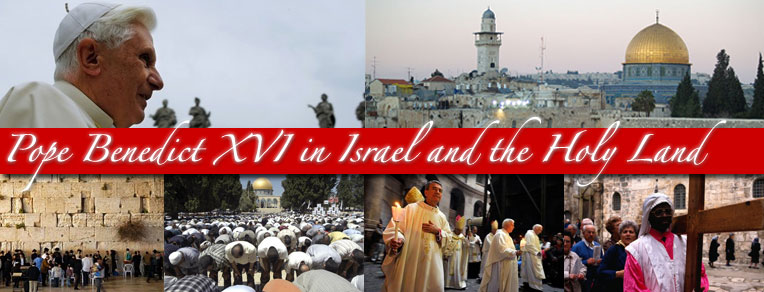
A pilgrimage to the Holy Land is a life-changing experience for those who believe in Christ. Even though the sites we revere today we may not be the precise spots mentioned in the Gospels, when you visit Galilee, Nazareth, Bethlehem, Jerusalem and other ancient places in modern-day Israel, the presence of Jesus , Mary and Joseph, the Apostles and the disciples -as well as the "villains" in the story of our salvation-becomes palpable. Galilee and Jerusalem, especially, make indelible impressions on the heart and soul.
When I first visited Israel I had only a point and shoot 36mm film camera. On my second, I had better digital equipment. In anticipation of Pope Benedict's visit, I thought I would share with the forum some of my impressions of the places where he is scheduled to go.
Wednesday, May 6, 2009
"A preview of the Pope's pilgrimage to the Holy Land"
From "rcesq" -- a longtime contributor of our Pope Benedict Forum:


Pope Benedict's Pilgrimage to Israel - Roundup
- An Iraqi newspaper yesterday quoted an unnamed lawmaker as saying that Pope Benedict may visit Baghdad as part of his tour of the Middle East (CathNews May 5, 2009) -- however, Vatican spokesman, Fr Federico Lombardi and The Apostolic Nuncio to Iraq and Jordan, Archbishop Francis A. Chullikat, denied the story (Catholic News Agency May 5, 2009).
- The Central Statistical Office of the Church has published information detailing the presence and ministry of the Church in the region, in anticipation of the papal pilgrimage.
Among other statistics, the report states that "Jordan has a population of 5,720,000 of whom 109,000 (1.91 percent) are Catholic" and "Israel and the Palestinian Territories have a population of 7,180,000 of whom 130,000 (1.81 percent) are Catholic." (The report is a bit dated, having been last updated as of December 31, 2007).
On a related note, the Associated Press reports: When Pope Benedict XVI comes to the Holy Land next week, he will greet a community of believers whose numbers are gradually eroding" (May 6, 2009):
Dwarfed by Jewish and Muslim populations, young Christians are increasingly leaving to seek their futures elsewhere, especially those in the Palestinian territories and east Jerusalem. Christians say they are treated with suspicion by both Jews and Muslims and feel caught in an increasingly polarized conflict between them.
"It became a Muslim cause and a Jewish cause, so Christians, we have nothing to do," said Zakaria Mishriki, a 32-year-old Christian storekeeper in Jerusalem's Old City who has cousins in several U.S. states and Canada.
The last decade has also seen rising Islamic sentiment in Palestinian society, which has increased pressure on Christians, said Mishriki, whose shop offers wooden nativity scenes and crucifixes.
Meanwhile, Jewish Israelis do not differentiate between Muslims and Christians and consider all Palestinians a threat, added Mishriki, who was born to a Catholic family and now considers himself Protestant.
- That said, Israel anticipates 10,000 Christian pilgrims to accompany Pope Benedict XVI on his trip to the Holy Land next week, and an increase in the number of Catholic visitors this year as a consequence, according to Tourism Minister Stas Meseznikov. Jerusalem Post May 6, 2009. Meseznikov also noted that the number of Catholic tourists will be exceeded by the number of evangelicals:
Three million tourists visited Israel last year, including 1.8 million Christians, breaking the record set in 2000.
A whopping 70 percent of Christian tourists last year were evangelicals, Meseznikov said.
- Zenit News reports that The king of Jordan plans to break protocol this Friday when he receives Benedict XVI (May 5, 2009):
[Jesuit Father Federico Lombardi] noted that King Abdallah II will welcome the Pontiff at the airport where he is scheduled to arrive at 2:30 p.m.. And in a particularly unusual gesture, he and Queen Rania will again accompany the Holy Father to the airport when he leaves on Monday.
King Abdallah II has been a vocal advocate of interreligious dialogue -- his Amman Message (27th of Ramadan 1425 AH / 9th November 2004) encouraged the Islamic world to forsake extremism. In addition:one of King Abdallah's advisors is Ghazi bin Muhammad, who coordinated the initiative from 138 Muslim scholars who responded to 2006 attacks against the Pope following his address in Regensburg.
It was this group who wrote "A Common Word," which eventually led to the formation of the Catholic-Muslim Forum in Rome.
- The visit to the Holy Land was among the first that Benedict wanted to make, says Cardinal Leonardo Sandri, prefect of the Congregation for the Eastern Churches. Zenit News has the interview:
"He had to make the trips that were already scheduled in the preceding pontificate," the cardinal explained, pointing to World Youth Day in Cologne and the World Meeting of Families in Spain.
But, he added, the Pontiff's "great desire as a first trip and, we could say, as the meaning of the whole of his pontificate toward Jesus, toward the Word of God, was to go to the Holy Land. The principal trip to set the tone of all of his pontificate was this one."
Palestinians, Israelis vie for Pope Benedict's attention to their cause
An AsiaNews.it article by Abib Khoury gives some indication of how the residents of Refugee Camp Aida plan on greeting the Holy Father May 4, 2009: Meanwhile, Breuer Press International has details on President Shimon Peres' official reception for Pope Benedict on May 11th:
The program for this visit is in its final stages and plans that the pope will be welcomed among the crowd divided into two wings with a children’s choir singing songs of welcome as well as murals and banners and Palestinian and Vatican flags. The visit is to last at least one hour. It will begin along the Security Barrier that Israel has built around all Palestinian localities to protect itself from terrorist attacks and which is the source of endless problems of movement for the Arab population. It will be followed by an exhibition which through images will seek to highlight the reality of the Palestinian situation and its history; a speech by the president of the Palestinian Authority Mahmoud Abbas, and then an address by Benedict XVI.The camp inhabitants want to present the pope with two gifts: a chain with a key attached to it, a link – they say - between the keys of St Peter and the “key to return” of the refugees (many refugees have kept the keys to their homes from which they were expelled or forced to flee, as a sign of their hope to go home). The second gift is a map of Palestine sculpted in Tiberiad rock.
For his visit to Bethlehem, the Mayor (a Christian) asked a local Muslim artist to inscribe and decorate a copy of the Gospel of Saint Luke. The artist 51 year-old Abu Sima, is a refugee who originally fled Iraq, the Jordan and who now resides in Bethlehem.
“Through this humble work – he declares – I wish to send out a message that the Muslim artist is a pacifist. And this despite the attacks that are carried out in various parts of the world by the hands of extremists, who exploit our religion for their own ends”.
Meanwhile, Breuer Press International has details on President Shimon Peres' official reception for Pope Benedict on May 11th:The Pope will arrive at the President’s Residence at 16:05 and will be received by the President on a red carpet. Two children, a Christian and a Jew from Nazareth and Upper Nazareth, respectively, will present the Pope with a basket of fruit and will welcome him in English in Hebrew. The Pope will also be presented with the “Seven Species” of plants named in the Bible and other Israeli-made produce, including a new strand of wheat developed by the Volcani Center and named Benedict XVI after the Pope.After the Pope enters the President’s Residence, the two will hold a working political meeting in the conference room. During the meeting, President Peres is expected to raise the strengthening of ties between Israel and the Vatican, the advancement of the peace process between Israel and the Palestinians, and the readiness of the people of Israel to make peace, and he will ask the Pope to increase his involvement in the making of peace in the Middle East. He will note that there is a special role for religious leaders in bringing about peace and breaking the connections between religion and terror.
Immediately following the meeting, there will be a tree-planting ceremony for a tree of peace - an olive tree in the garden of the President’s Residence, after which will begin the aforementioned ceremony with 700 representatives of all different walks of life in Israel.
At the celebratory reception, the Pope and President Peres will deliver speeches. This will be followed by an artistic event with the participation of Children’s Voices for Peace, a choir from the diverse community of Jaffa consisting of Muslim, Jewish, and Christian children who will sing the song “Hallelujah.”
Disputes over sovereignty of Christian holy sites continue?
Israeli President Shimon Peres has suggested that Israel give up sovereignty of Christian holy sites to the Vatican, according to a report on the Israeli Army Radio (Christianity Today, May 5, 2009):
According to the report the President is urging the government to give control of six key sites to the Vatican, including the Church of the Annunciation in Nazareth, the Coenaculum on Mount Zion and the Gethsemane on the Mount of Olives in Jerusalem and the Church of the Multiplication on the Kinneret.RelatedHowever, the plan is reportedly being opposed by the Israeli Interior Minister, Eli Yishai, whose department reportedly refused to sign documents on Sunday handing over sovereignty to the Vatican.
Yishai was quoted as saying, "Every concession like this limits the Israeli government's ability to function as a sovereign government in the area … I am certain that the aim of the pope's visit [from 11-15 May] is not to cause damage, and not to gain sovereignty," reports the Jerusalem Post.
- Property disputes dog Vatican-Israel ties Associated Press. May 6, 2009:
Israeli and Vatican lawyers have been disputing ownership of land occupied by a Catholic charity in Jerusalem for 35 years -- just one of many longstanding property issues that form an uneasy backdrop to Pope Benedict XVI's visit to Israel next week.
UPDATE!
Catholic News Service reports that Israeli and Vatican officials denied reports that Israeli President Shimon Peres had asked the government to relinquish sovereignty over several holy places as a gesture of good will for Pope Benedict XVI:
"What was published was taken out of context," a spokeswoman for the president's office said May 6. "The Israeli media published it as if the president was asking to give up sovereignty over holy sites, and there is a great distance between that and the reality."The spokeswoman said Israel already has pledged to the Vatican that it will not confiscate land around six Christian sites for any sort of national development purpose such as the widening of roads. She said Peres had asked the ministries, as a gesture of good will before the pope's May 8-15 trip to the Holy Land, to confirm the pledge and to speed up the negotiations.
No, Michael Ben Ari, the Pope is most definitely NOT a Nazi
National Union MK Michael Ben Ari declared Tuesday that next week's visit by Pope Benedict XVI, whom he referred to as a former member of the Nazis' youth movement, would be an insult to the memory of Holocaust victims, Haaretz reports:
"A state welcome for the pope would be turning our backs on the millions of Jews who were killed in the shadow of the Christian religion of grace and mercy," Ben Ari was quoted as saying by Israeli media. "This pope was a member of the Hitler Youth."The claim that Pope Benedict XVI harbors Nazi sympathies and is anti-semitic is born of complete ignorance about the life of the Holy Father. That he was an obligatory and unwilling "member" of the Hitler Youth is true, as far as it goes. And from the way this fact has been presented, one might assume this is one of those dirty little skeletons the Pope kept tucked away in his closet (next to his Inquisitor's sword and the token heads of renegade theologians).He made the comments at a Knesset session in which he called on lawmakers to rethink the pope's visit.
Ben Ari, a former member of the outlawed Kach movement [curiously, "barred from participating in the next election in 1988 under the revised Knesset Elections Law banning parties that incited racism" - Wikipedia], further said the Catholic Church is, and has always been, driven by anti-Semitic motivations.

Likewise, John Allen Jr., journalist for the National Catholic Reporter and author of 2002's biography Cardinal Ratzinger: The Vatican's Enforcer of the Faith, provides the historical context sorely lacking in most exposes of this nature ("The Vatican's Enforcer", National Catholic Reporter, April 16, 1999):
See also:As a seminarian, he was briefly enrolled in the Hitler Youth in the early 1940s, though he was never a member of the Nazi party. In 1943 he was conscripted into an antiaircraft unit guarding a BMW plant outside Munich. Later Ratzinger was sent to Austria's border with Hungary to erect tank traps. After being shipped back to Bavaria, he deserted. When the war ended, he was an American prisoner of war.
Under Hitler, Ratzinger says he watched the Nazis twist and distort the truth. Their lies about Jews, about genetics, were more than academic exercises. People died by the millions because of them. The church's service to society, Ratzinger concluded, is to stand for absolute truths that function as boundary markers: Move about within these limits, but outside them lies disaster.
Later reflection on the Nazi experience also left Ratzinger with a conviction that theology must either bind itself to the church, with its creed and teaching authority, or it becomes the plaything of outside forces -- the state in a totalitarian system or secular culture in Western liberal democracies. In a widely noted 1986 lecture in Toronto, Ratzinger put it this way: "A church without theology impoverishes and blinds, while a churchless theology melts away into caprice."
- Ratzinger a Nazi? Don't Believe It! by Sam Ser. Jerusalem Post April 18, 2005 - written in response to an article that appeared in the Sunday Times (London) on April 17, 2005.
- New Pope Defied Nazis As Teen During WWII, by the Assoc. Press. New York Times April 23, 2005.
- Jewish leaders say pope's past cause for optimism, not concern, by Cindy Wooden. Catholic News Service. June 13, 2005.
- Pope Benedict, the Jews and the State of Israel Catholic Friends of Israel May 6, 2009.
Pope Benedict, The Jews and the State of Israel
In "Pope Benedict and the Jews" (Jerusalem Post March 29, 2009), Rabbi David Rosen seeks to alleviate concerns resulting from the lifting of the excommunications of Bishop Richard Williamson and his fellow bishops of the SSPX:
* * *
See also:
 Notable Statements by Pope Benedict XVI to the Jewish People
The Vatican and the pope have made it clear that the lifting of the excommunication ban is not a reinstatement of these bishops, who will not be accepted back into the church until they affirm the teachings of the Second Vatican Council which include the positive teachings on Jews and Judaism. But above all the pope has not only reaffirmed the Church's unqualified repudiation of anti-Semitism and Holocaust denial, he has reiterated the importance of Holocaust education and he has especially repeated his own profound commitment to continuing the path of his predecessor in advancing Catholic-Jewish relations.Rosen then runs through a list of notable facts concerning Pope Benedict and his relationshiop to the Jewish people:Those who are familiar with Pope Benedict XVI's record will not at all be surprised by this.
- Benedict was the first pope to invite Jewish leaders both to the funeral of Pope John Paul II and, above all, to the celebration of his own ascension to the throne of St. Peter in 2005.
- Less than a month into his pontificate, he received a delegation of the International Jewish Committee for Interreligious Consultations, reaffirming his intent to continue upon "improved relations and friendship with the Jewish people" in the steps of his beloved predecessor, John Paul II.
Visiting the extermination camp of Auschwitz-Birkenau in May 2006, Benedict characterized anti-Semitism as an assault against the very roots of Christianity, implying that "a Christian to harbor such sentiment is to attack and betray his or her own faith":
"those vicious criminals, by wiping out this people, wanted to kill the God who called Abraham, who spoke on Sinai and laid down the principles to serve as a guide for mankind ... By destroying Israel, by the Shoah, they ultimately wanted to tear out the taproot of the Christian faith and to replace it with a faith of their own invention."
- As Cardinal Ratzinger, he was on the Special Committee of the Holy See that reviewed and authorized the establishment of full relations between Israel and the Vatican -- upon which he phoned Prof. Zwi Werblowsky, one of the Jewish Israeli pioneers of interfaith dialogue, "to express his joy over this development, describing it as the fruit of the work of the Second Vatican Ecumenical Council."
Pope Benedict XVI greets Jewish delegation leader Rabbi David Rosen (C) at the Vatican October 30, 2008. Source: Reuters
In Benedict XVI and the State of Israel (First Things), David P. Goldman (who writes under the
pseudonymn "Spengler") examines the Pope's theological perspectives on Israel's founding. According to Goldman, it is notable (though largely unmentioned in the press) that the Pope's visit will overlap with Israel's Independence Day (celebrated on May 14, 2009, according to the Jewish rather than the Gregorian calendar), recalling the declaration of the State of Israel in 1948 -- and that on May 15, designated by Palestinians as a day of mourning ("Disaster (Naqba) Day"), he will share a podium in Israel's capital Jerusalem with Israeli President Shimon Peres.
Simply a coincidence? -- consider:
Well before the establishment of diplomatic relations with Israel in 1993, then Cardinal Ratzinger repeatedly explained to Jewish representatives that the delay in diplomatic recognition solely reflected the concern of the Holy See for the vulnerable Arab Christian communities. His pilgrimage this May devotes considerable time to pastoral meetings with the Arab Christian community. Nonetheless, Benedict has made clear that his concern for Arab Christians is embedded within an unwavering commitment to the Jewish community in the Holy Land.Goldman concedes that "The Magisterium of the Church does not take an explicit position on the question of Jewish statehood"; in fact, the "Notes on the Correct Way to Present the Jews and Judaism in Preaching and Catechesis in the Roman Catholic Church" (1985) specifically states:It is hard not to see an evolution in Vatican policy towards Israel, from a pragmatic approach to the problems of religious constituencies, to explicit theological sympathy for the Jewish State. Benedict XVI is first of all a theologian, and he views the Jewish presence in the Holy Land as a theological matter.
In 2008, on the fiftieth anniversary of Israel's independence, Benedict XVI told Israel's ambassador to the Holy See, "The Holy See is united with you and thanks God for the full realization of the Jewish people's aspirations to live in its homeland, the land of its forefathers." Meeting with the Israeli rabbinate on March 12, the Pope affirmed the election of the Jewish people "to communicate to the whole human family knowledge of and fidelity to the one, true and unique God."
"The existence of the State of Israel and its political options should be envisaged not in a perspective which is in itself religious, but in their reference to the common principles of international law."Yet, as Goldman notes, this assertion stands almost in tension with the very next sentence, which draws from Pope John Paul II's recognition of the theological significance of Jewish survival:
"The permanence of Israel (while so many ancient peoples have disappeared without trace) is a historic fact and a sign to be interpreted within God's design. . . . It remains a chosen people, "the pure olive on which were grafted the branches of the wild olive which are the gentiles."Indeed, in 1994, explaining the establishment of diplomatic relations with the State of Israel, Pope John Paul II asserted:
It must be understood that Jews, who for 2,000 years were dispersed among the nations of the world, had decided to return to the land of their ancestors. This is their right."As Goldman remarks:
Theologically it is difficult to separate the election of the people from the promise of the land, and Benedict's commitment to Israel seems strongly grounded in theology.Not to characterize Benedict as a card-carrying Zionist (a loaded term), but at the very least I think one could acknowledge that this pope is cognisant of the place of Israel in the hearts of the contemporary Jewish people -- and, like his predecessor, supportive of their right of return.
- Pope Benedict XVI and the Jews - an exploration of "what does Cardinal Ratzinger, Pope Benedict XVI, actually think about the Jewish people?" (The Benedict Blog April 26, 2005)
- Pope Benedict XVI, Auschwitz, and the Nature of Anti-Semitism Against The Grain May 30, 2006.
- Pope Benedict XVI's visit to the Park East Synagogue (New York City) Benedict in America April 18, 2008.
Notable Statements by Pope Benedict XVI to the Jewish People
- "On the Shoah" - General Audience Rome, January 28, 2009
- Address to the Conference of Presidents of Major American Jewish Organizations Rome, February 12, 2009.
- Meeting with representatives of the Jewish community at Park East Synagogue in New York (April 18, 2008)
- Prayer to commemorate the victims of the Concentration Camp of Auschwitz-Birkenau (May 28, 2006)
- Visit to the Synagogue of Cologne, Germany (August 19, 2005)
On John Paul II and the Jews

Sunday, May 3, 2009
Pope Benedict's Pilgrimage to Israel - Roundup
News
- In reflections ahead of the Easter prayer, the Regina Caeli, Benedict XVI asked for prayers for vocations and for his imminent journey to the Holy Land (AsiaNews.it May 3, 2009):
“With my visit – explained the pope – I aim to confirm and encourage the Christians in the Holy Land, who are faced with no small amount of difficulties each and every day. As successor to the Apostle Peter, I will bring to them the support and closeness of the entire Church. Moreover, I will be a pilgrim of peace, in the name of the one God, the Father of all. I will be a witness of the Catholic Churches commitment in favour of all those who struggle to practice dialogue and reconciliation, to reach a stable and lasting peace in justice and shared respect. Finally, this voyage cannot avoid being of notable importance for ecumenism and inter-religious dialogue. Jerusalem is, from this point of view, the symbolic city par excellence: there Christ died to unite all of Gods lost children (Jn 11,52)”.
Benedict XVI's May 8-15 trip to the Holy Land is a pilgrimage, not a political event, emphasized Father Federico Lombardi in the most recent edition of Vatican Television's "Octava Dies." Zenit News reports:
He called the journey the "most awaited" trip the Pope has made thus far, and possibly the "most binding."
Father Lombardi clarified that it is "above all a journey of faith," even if events in the Middle East are always interpreted in a political key.
[...]
the "political situation in the area is very uncertain, and also the possibilities of peace are fragile. But the Pope all the same sets out, with an admirable courage that is based on faith, to speak of reconciliation and peace."
"All of us," he affirmed, "should accompany him not only with ordinary prayer, but also with that spiritual movement that John Paul II called the 'great prayer' -- so that the Church is renewed in its sources, so that the union between Christians grows closer, and so that hate finally gives way to reconciliation." [More]
- According to Haaretz, Israel's police and the security establishment have no specific information about potential attacks targeting Pope Benedict XVI:
Speaking at a briefing ahead of the pontiff's visit, Maj. Gen. Shimon Koren said the police will deploy thousands of personnel around the site of the planned mass on Precipice Mountain and at the Basilica of the Annunciation. The police and the Shin Bet are providing security for the events.
Koren also said that as of yesterday, no requests had been filed to demonstrate against the Nazareth visit. The police will approve protest requests so long as they do not overshadow or disrupt the pope's visit, he said.
- An Israeli research group reports that the Christian population of Jerusalem has shrunk to 14,000, down from 31,000 at the end of the British Mandate – only 2 percent of the city's population, and far fewer than the 20 percent it constituted in 1946 (Israel National News May 2, 2009):
The report, prepared by Dr. Amnon Ramon of the Jerusalem Institute for Israel Studies, says that most of the younger generation of Christians who were born in Jerusalem have left the city – many emigrating abroad, to the United States, Canada, and South America. "Actually, the vast majority of the non-Arab Christian population has already left the city," Dr. Ramon said, adding that many members of the Arab Christian communities have left as well, with many moving to Jordan. Out of the 14,000 Christians living in the city today, 2,600 are nuns, monks, and clergy studying in the city. [More]

An Israeli postal worker shows a new set of stamps issued to mark the upcoming visit of Pope Benedict XVI to the Holy Land at her office in Jerusalem on May 3, 2009. The stamps, which will be available to the public starting May 4, show holy Christian sites which the pope is due to visit during his trip. The pope will visit Jordan, Israel and the Palestinian territories between May 8 and 15. Source: Getty Images
- Israel Police and the Israel Security Agency (Shin Bet) have announced that the Western Wall will not be closed to Jewish worshippers during the Pope’s visit (Israel National News May 3, 2009):
The two bodies made the decision, overturning their previous intention, in response to a request by the Rabbi of the Holy Sites, Rabbi Shmuel Rabinovitch.
The original decision had caused a minor uproar among the religious community, hundreds of whose members never miss their regular daily prayer service at the holy site.
- Nazareth: Off the beaten track in Jesus' hometown - Matti Friedman (USA Today) profiles the stomping grounds of our Lord and Savior:
NAZARETH, Israel — When Pope Benedict XVI pays a visit next month to the town where Jesus grew up, he will bring brief attention to a Holy Land destination that is at once world famous and unjustly overlooked.
The Washington Post also has a lengthy article on Nazareth, and the town's hopes that the Pope's visit will bring about a revival in the tourist trade:Like the tour groups bused into Nazareth for lightning visits on their way to somewhere else, the pope will see the Basilica of the Annunciation, on the site where Christian tradition says an angel told Mary she would bear the child of God.
Like most visitors, the pope likely won't have the chance to savor the shabby Ottoman chic of the Old City, consume too many of Abu Ashraf's honey-drenched pastries, or watch the young and hip show off their clothes and cars opposite the Dandana restaurant. It's safe to assume he will not experience the ear-spitting repertoire of Chaos, Israel's only Arab heavy metal band. ...
"People will be told, 'Nazareth, Nazareth, Nazareth.' We believe this is the most important Christian city in the world," said Tareq Shehada, general manager of the Nazareth Cultural and Tourism Association.
"Nazareth has been a day-tripper's site," where tour buses often stop for a few hours before delivering passengers to hotels in other cities, he said. "We feel it should be a tourist city. Not a tourist site."
Commentary
- Test for a reluctant pope (The National May 1, 2009). A profile of the Holy Father written by Damian Thompson (Holy Smoke).
- Pope to Confront Myriad Challenges in Holy Land Trip, by Francis X. Rocca. (Religion News Service) May 1, 2009.
What do you feed the Pope?
Here's a challenge you don't encounter every day: Jordan hotel owner agonizes over what to feed pope (Associated Press):
A Jordanian hotel owner preparing a lunch for the pope spent five weeks coming up with a choice of five menus for the upcoming visit and is still agonizing over what could go wrong — just as he did when John Paul II visited nine years ago.Said Sawalha said the Vatican chose a light meal of beef medallions, vegetables and pineapple cake, a menu designed to keep the 81-year-old Benedict XVI's energy up on his Holy Land tour starting later this week in Jordan.
"I have been having anxieties that anything could go wrong," said Sawalha, owner of the Regency Hotel in Amman. "I mapped out plan Bs to everything, from having the pineapple cake fall to a flat tire as we transport the food to the banquet hall."
[...]
[Salwa] said he has worked for the last five weeks, consulting with top chefs in Jordan and abroad, to set a menu for the Pope's lunch.
A pineapple cake decorated with yellow and white cream, resembling the Vatican emblem, will be served for desert.

Foreign Ministry launches website dedicated to Pope Benedict's pilgrimage to Israel
The Foreign Ministry of Israel inaugurated on Sunday a website dedicated to the upcoming pilgrimage of Pope Benedict XVI to Israel, set to take place between May 11-15.Source: Jerusalem Post.The website, accessible at http://popeinisrael.org.il, is presented in eight languages (English, French, Spanish, Portuguese, Polish, Italian, German and Hebrew). It contains textual and audio-visual information on the Papal pilgrimage, Israel-Vatican relations, Christian communities in Israel and Christian holy sites throughout the country.
The site will also provide regular updates throughout the course of the visit, as well as live broadcasts of events during the Pope's pilgrimage, such as the visit to Yad Vashem, masses at the Garden of Gethsemane and at the Mount of the Precipice, and visits to the site of the Last Supper and to the Church of the Holy Sepulcher.
Saturday, May 2, 2009
Custody of the Holy Land: "The Cedron Valley - site of Benedict's May 12th Mass in Jerusalem"
 The Cedron Valley: the site of the mass in Jerusalem on 12th May - an introduction from the Franciscan Custody of the Holy Land:
There are many churches in Jerusalem, but none would be large enough to hold the crowd wishing to attend the Mass of a Pope on his pilgrimage. ...The largest Catholic church is the Church of all Nations, or of Gethsemane and holds 800 people, but that was still not large enough and so it was decided to hold the celebration in the open. The Franciscans offered a part of the land they acquired in 1666, which at the time was probably a single piece of land together with the Garden of the Olives. It was only later that history separated the two plots of land.
The Mass will thus be celebrated on the piece of land beneath the Garden of Olives and the Garden of Gethsemane before an estimated crowd of some 5000 people.
Of the three sites chosen for Benedict XVI’s Masses, this is the one that offers the opportunity to follow in the steps of Christ. [More]
Rabbi David Rosen on Benedict's pilgrimage and anticipated impact on Jewish-Christian relations
 Rabbi David Rosen, director of interreligious affairs for the American Jewish Committee, recently spoke on the papal pilgrimage and its anticipated effect on Catholic-Jewish relations:
"Pope Benedict XVI will be walking in the footsteps of his great predecessor both literally and figuratively. Pope John Paul II -- very much the hero of Catholic-Jewish reconciliation in our times -- understood full well that the visit of a pope to Israel has a special significance of its own," he said.Rabbi Rosen's remarks were made in the April 29 English-language edition of the Vatican newspaper, L'Osservatore Romano.Rabbi Rosen said that even if the visit of Pope John Paul in 2000 was described as a pilgrimage "it was still a state visit with all the relevant trappings" and recognized the essential relationship between the Jewish people and the land of Israel. Pope Benedict, too, will be demonstrating more than good will to the 6 million Jews who reside in the Holy Land today, he said.
The rabbi said a papal visit can give wider expression to some of the principles and values familiar to dialogue experts.
"Most Israeli Jews and especially the more traditional and observant among them have never met a modern Christian," he said. But when they saw Pope John Paul visit the Yad Vashem Holocaust memorial and the Western Wall and heard what he had to say, they realized the head of the Catholic Church was a "sincere friend," he said.
"How do you, even if you are the pope, talk peace to men like that, or to mothers who dress their sons in suicide belts?"
Denis Maceoin says that Benedict could not travel to Jerusalem at a more difficult time. The Israeli-Palestinian conflict has entered a very dark phase since Israel's defensive assault on Gaza at the end of last year":
That darkness has less to do with the region itself than with a swelling international hate-fest against Israel that is now growing into a frightening resurgence of anti-Semitism in many European countries. Everything the pope says and does throughout his visit will be watched and weighed against an array of what will often be incoherent and disturbing attitudes and policies, not least the global Islamist and left-wing call for Israel to be destroyed and, in more extreme versions, for the Jews there to be killed.The pope will go there as a man of peace, and will take every opportunity to advocate peace in the region. But peace may not be the most important thing for him to urge. Nor will any exhortations he may make be enough to make the peace process go forward anyway. The 1988 Hamas Charter declares: "Initiatives, and so-called peaceful solutions and international conferences, are in contradiction to the principles of the Islamic Resistance Movement... There is no solution for the Palestinian question except through jihad. Initiatives, proposals and international conferences are all a waste of time and vain endeavors" (Article 13).
How do you, even if you are the pope, talk peace to men like that, or to mothers who dress their sons in suicide belts?
Hamas terrorists teach the art of suicide bombing to a 5-year-old. Hamas, Islamic Jihad and Hezbollah are veterans of using children as human shields, human bombs and for propaganda posters to incite further terrorism.
Notre Dame Cultural Center, Jerusalem: three faiths dialogue in anticipation of papal pilgrimage
The Jerusalem Post reports on a meeting of local Muslim, Catholic, Jewish and Protestant communities met at the Notre Dame Cultural Center in Jerusalem in anticipation of the papal visit.
Some, like Bishop Dr. Munib Younan, head of the Evangelical Lutheran Church in Jordan and the Holy Land, engaged in political speculation (hoping Benedict would support a 2-state solution and reject "occupation and settlements"); others, like Father William Shomali, rector of the Latin Seminary in Bet Jala, expressed hope that Benedict's example would help assist in recognizing the suffering of "the other":
"The pope will visit Yad Vashem to recognize the suffering of the Jews, he will visit with the Armenians to remember their suffering and the 1.5 million who were killed, and he will also devote time to acknowledging the Palestinian people's suffering," Shomali said. "I hope the holy father will help all of us escape our complexities of victimization. Part of the process of reconciliation is admitting one's guilt."Recalling the public spats between Jewish and Muslim leaders during the visit of John Paul II in 2000, Shomali noted "each side spoke exclusively about their own suffering."
Additional contributors included Prof. Mohammed Dejani, founder and director of the American Studies Institute at Al-Quds University in east Jerusalem, and Dr. Deborah Weissman, co-chairwoman of the Interreligious Coordination Council.
The symposium was sponsored by the US State Department; Mercy Corps, a nondenominational Portland, Oregon-based aid organization; and the Interreligious Coordination Council in Israel, a coalition of 70 Christian, Muslim and Jewish groups.
Aida Refugee Camp expects Pope Benedict to plead their case
Catholic News Service's Judith Sudilovsky interviews various residents from the Aida Refugee Camp and their expectations for the papal visit (April 29, 2009):
When her children were growing up there was an open field opposite their apartment building and she would spend most of her time there, letting them tumble about as they enjoyed picnic lunches. Today, the building -- which has grown by four floors as sons and cousins have married and built apartments for their wives -- overlooks the stage in front of the Israeli separation barrier from which the pope will address the camp's 4,860 residents.
Palestinian workers build a stage next to Israel's separation barrier in the Aida refugee camp near the West Bank town of Bethlehem. Source: AP
While much of the camp is a jumble of narrow, sunless, garbage-strewn alleyways, on his visit the pope will be taken down the wide dusty main road to the stage abutting the wall, which separates the camp from Bethlehem.According to the article, the Pontifical Mission for Palestine -- a Vatican-founded relief agency under the direction of the New York-based Catholic Near East Welfare Association -- is helping provide aid and assistance to the residents of the camp:"I don't know what he is coming to do," said Mourad Malash, 23, who is unemployed and spends his time between his home and the houses of his friends. "He should ask the youth how they feel. Can he find jobs for the people?"
"The most important man in the world is coming here. He can bring thousand of journalists with him (to see our life here)," [Salah] Ajaram said. "He can be close to the wall and see how the wall separates our lives between our people. He is the one to talk about justice and peace. We feel there can be no justice without the right of return and the pope can take this message out with him.Salah Ajaram, 36, is general manager of the camp's Lajee cultural center and a member of the coordinating committee for the pope's visit. (Read the rest of Catholic News Service's report)."To stay in your country as a refugee is more difficult than living as one outside," Ajaram added.
Friday, May 1, 2009
The Equestrian Order of the Holy Sepulcher of Jerusalem
 The Boston Pilot reveals that the Pope's visit to the Holy Land is financed, in part, by the Equestrian Order of the Holy Sepulcher of Jerusalem, re-established by Blessed Pope Pius IX in 1847 for the support of he Latin Patriarchate of Jerusalem and other Catholics living in the Holy Land. The newspaper interviews U.S. Cardinal John P. Foley, grand master of the order:
To support the trip with prayer and finances is to support the pope in his mission as the successor of Peter, Cardinal Foley said.Read the rest."He will do what Peter always does: encourage the faithful, recognize them, give them a renewed sense of worth and let them know how much the universal church appreciates them and the importance of their faith," the cardinal said.
The order has about 24,000 members in 32 countries, the cardinal said. Members propose other Catholics for membership and, with the local bishop's approval, they are invested in the order.
Each member pledges to pray each day for the good of the church, the work of the Latin patriarch of Jerusalem and the holy sites associated with the life of Jesus, and for strength in exercising their obligation of charity, especially toward "the poor and sick in the Holy Land."
On the Web
- Equestrian Order of the Holy Sepulcher of Jerusalem - Official Website [U.S.]
- Equestrian Order of the Holy Sepulcher of Jerusalem - Official Website [Jerusalem]
- The Order of the Holy Sepulchre - ChivalricOrders.org - a substantial entry on the history of the order.
Subscribe to:
Posts (Atom)

 Posts


