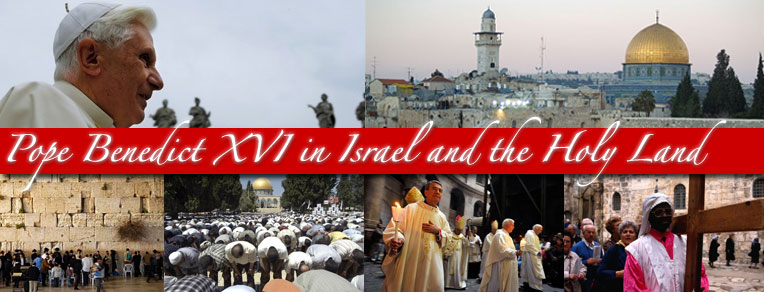
- Pope sees Holy Land’s great divide, by Julian Rake:
Pope Benedict has crossed through the imposing concrete wall that separates the West Bank town of Bethlehem from Israel to visit the town of Jesus’ birth. The wall is part of the nearly 800 km security barrier that Israel is building in and around the West Bank in a series of walls, fences, berms and ditches. He was accompanied to the checkpoint on the Israeli side by Israeli security before driving through the barrier to meet up with his Palestinian security escort.
Julian provides some video of the Pope's passage from Israel into Bethlehem.Crossing back and forth through the checkpoints that dot what Israelis call the “separation barrier” – and which Palestinian President Mahmoud Abbas told the pope was “the apartheid wall” – is a routine part of life for many people here. Yet it can shock newcomers to see this physical manifestation of the conflict in a region that is just a pocket-handkerchief on the map of the world. It is a measure put in place for security (as per the Israelis) or annexation and grabbing of land (as per the Palestinians). One wonders what the Pope was thinking as he crossed through.
- Tom Heneghan notices that, during his visit to the Dome of the Rock on Tuesday, Pope Benedict urged Palestinian Muslim leaders to pursue interfaith cooperation by using an argument that other Muslims have been using to engage Christians — including himself — in dialogue:
Also, FaithWorld provides video footage of the Pope's visit to the Dome of the Rock.In his speech to Muslim leaders this morning, the pope said reason shows us the shared nature and common destiny of all people. He then said: “Undivided love for the One God and charity towards ones neighbour thus become the fulcrum around which all else turns.” Readers of this blog may recognise that message in a slightly different form — it echoes the “Common Word” appeal by Muslim scholars to a Christian-Muslim dialogue based on the two shared principles of love of God and love of neighbour. Since we’ve reported extensively about that initiative, readers may also remember that the Vatican was initially quite cautious about it. Up until the Catholic-Muslim forum in Rome last November, the line from the Vatican was that Christians and Muslims couldn’t really discuss theology because their views of God were so different. Vatican officials sounded different after three days of talks and Cardinal Jean-Louis Tauran, who is in charge of interfaith relations, said the Common Word group could even become a “privileged channel” for discussions in future. And now Benedict uses their argument to other Muslims.
Parsippany developer, Holocaust survivor meets Pope Benedict XVI, by Rob Jennings. The Daily Record profiles Edward Mosberg, a New Jersey developer who, in the words of his lawyer, was "asked if he would be one of six persons representing six million":
Starting approximately 20 years ago, Mosberg began collecting memorabilia associated with the Holocaust — ranging from shoes, wires, spoons and Torahs that survived the Nazi destruction. In 2006, he presented a nearly 20-year-old Torah that had been hidden in someone’s home to the Mount Freedom Jewish Center.
Mosberg, a native of Krakow, Poland who now lives in Union, was the only member of his immediate and extended family to survive the Holocaust. His wife, Cecile, lost her mother, two older sister, younger brother and aunts and uncles.
“He loses his whole family. He’s in any number of camps. He has to participate in any number of work camps. He has to go on marches. He’s kind of had the rainbow of all the horrific experiences you can imagine,” Till said.
- Scarves speak volumes in pope's Holy Land visit, by John Thavis (Catholic News Service):
Sometimes a scarf is worth a thousand words.
Pope Benedict XVI spoke carefully during his Holy Land pilgrimage in May -- so carefully that it occasionally seemed his talks were written by Vatican diplomats.
But the image and the message people will carry from his visit may have more to do with scarves than speeches. [More]
- What kind of gift does a pope give when he visits the Holy Land? This morning, the Holy See Press Office distributed a few pictures of presents Pope Benedict has brought along. (Catholic News Service)
- The Italian daily "Il Foglio" interviews George Weigel on Pope Benedict XVI's journey to the Holy Land. This is amusing:
IF: Do you think that his words are often manipulated by those who desire to give the impression of great conflict between faiths?
GW: I think it's more often the case that reporters simply don't have the intellectual equipment to understand, and explain, what the pope is actually saying. Regensburg is a perfect example. Of course, there is a lot that could be improved in Vatican communications.
Wednesday, May 13, 2009
Pope Benedict in Israel & the Holy Land - General Roundup


Further discussion -- and defenses -- of the Pope's address at Yad Vashem
A critical mind is one of the most important assets for moral and physical survival - but there are times when one's verbal battles must be chosen with more than usual care. This is certainly true of the pope, whose words in the Holy Land are being scrutinized under a microscope, much like the one needed to read the nano-Bible presented to him by President Shimon Peres.The author goes on to contrast John Paul II's approach to the matter with Pope Benedict's, noting: "The young Joseph Ratzinger had quite another wartime youth experience, and he lacks his predecessor's direct link between heart and speech." However, she adds:The pontiff's speech at Yad Vashem on Monday was philosophical. It is true that he did not make apologies for historic crimes in his speech. But he did something else, something urgent: He reminded the world that anti-Semitism is still rearing its ugly head, and he committed the Catholic Church to combating it worldwide - today and tomorrow.
The Bishop of Rome does seem to have chosen the road of reason over that of the heart. But it would be hard to claim that he is not making a supreme effort to explore it for heart-felt causes: to promote peace within and between human beings, and to purify the meaning of vital words such as human, freedom and rights.
Michael Sean Winters believes "before the enormity of evil that was the Shoah, silence is an appropriate emotional response" (America May 13, 2009):
Silence is not, of course, an appropriate political response and the Pope made clear that we must speak out so that the world will never forget what happened. But, he is being criticized for not saying something "touching" as one columnist wrote. It is unfair. [...]I do not know what Pope Benedict felt when he went to Yad Vashem. His words, "I have come to stand in silence before this monument, erected to honor the memory of the millions of Jews killed in horrific tragedy of the Shoah" seemed to me excruciatingly appropriate. This Pope – who never tires of telling us Christians that our faith is about God and therefore about us, not the other way round – seemed to be saying, "My visit here is not about me. It is about the victims and their God." That may not play well in an age when our culture encourages vicarious emotional responses. But, it struck me as profoundly true.
The Pope did what he does: He looked at us poor children of Eve and pointed us towards God. His emotional reticence keeps the spotlight pointed away from himself, not only because he is shy, but because the Pope believes his job is to shine the light on God in a world in danger of forgetting Him. At Yad Vashem, like Auschwitz-Birkenau, you can smell the evil, the radical absence of God. To point us to God in such a place is no small gift and no small ministry.
The Pope's Mideast's Minefields - The New York Times' "Room for Debate" blog:
Pope Benedict XVI’s tour of the Middle East this week was expected to cross several political minefields, and so it has. After his visit on Monday to the Yad Vashem Holocaust memorial, some Israelis complained that the German-born pope spoke only in generalities about the Holocaust and did not mention Nazi Germany. Does that criticism have some validity, or is it unfair?Responding to the question: Rabbi James Rudin (American Jewish Committee); Colleen Carroll Campbell (Ethics and Public Policy Center); Daniel Gordis (Shalem Center) and John L. Allen Jr. (The National Catholic Reporter).
Monday, May 11, 2009
Surveying the reactions to Pope Benedict XVI's address at Yad Vashem Holocaust Memorial
 Haaretz reports that The speech by Pope Benedict XVI Monday at Yad Vashem drew criticism from staff members of the Holocaust memorial, who described it as disappointing and lukewarm.:
The chairman of the Yad Vashem Directorate, Avner Shalev, said he expected the pope, "who is a human being, too," to draw on his personal experience to issue a stronger condemnation of Nazis and Germans, who were not directly mentioned in the speech.[...]
The chairman of Yad Vashem, Rabbi Yisrael Meir Lau, himself a Holocaust survivor, complained of the pope's usage of the word "millions" instead of the more specific "6 million" when speaking of the Holocaust's Jewish victims, as well as over his use of the word "killed" rather than "murdered."
"There's a dramatic difference between killed and murdered, especially when a speech has gone through so many hands," Lau said.
Lau also said that the speech "didn't have a single word of condolence, compassion or sharing the pain of the Jewish people as such. There was a lot about the pain of humanity, cosmopolitan words," Lau said. Lau, the chief rabbi of Tel Aviv and a former Ashkenazi chief rabbi of Israel, also described the speech as "beautiful and well scripted and very Biblical," however.

Not every Holocaust survivor disapproved, however. According to YNet News, the head of the Consortium of Holocaust Survivors' Organizations in Israel said that the criticism directed at the pontiff was exaggerated:
"(The pope) is not the president of a Zionist organization, so why should we have any complaints towards him?" Noah Frug said Monday night."He came here to bring the Church and Judaism closer together, and we should consider his visit positive and important," Frug said.
 Father Caesar Atuire, the delegate administrator of Opera Romana Pellegrinaggi (ministry of pilgrimage), deemed the Pope's visit a "courageous move". From a Zenit interview:
"The Catholic Church rejects all that is violence," he said, "and I think that, in this moment in which the Pope is visiting this country, it is appropriate to say that all of us have the mission that the Holy Father presented in his discourse: to work so that these tragedies do not happen again in the history of humanity."Furthermore, Father Atuire continued, "the Pope is German, the nation to which belonged the Nazis who organized the Holocaust."
His national origin, the priest suggested, gives even greater weight to his message and his pilgrimage to the holy places.
His words are particularly eloquent when he says, "we do not want these things to be repeated, and faced with the horror of what happened, we have to learn to do everything we can so that this world can be a better world," Father Atuire proposed.
Related
- At Yad Vashem, what pope doesn't say makes waves - Pope's speech at a key Holocaust site draws mixed reviews, by John Allen Jr. (National Catholic Reporter)
- In Jerusalem, pope walks into politics of interreligious dialogue, by John Thavis. (Catholic News Service)
Pope Benedict XVI visits Yad Vashem Memorial, Jerusalem
“I will give in my house and within my walls a memorial and a name … I will give them an everlasting name which shall not be cut off” (Is 56:5).This passage from the Book of the prophet Isaiah furnishes the two simple words which solemnly express the profound significance of this revered place: yad – “memorial”; shem – “name”. I have come to stand in silence before this monument, erected to honor the memory of the millions of Jews killed in the horrific tragedy of the Shoah. They lost their lives, but they will never lose their names: these are indelibly etched in the hearts of their loved ones, their surviving fellow prisoners, and all those determined never to allow such an atrocity to disgrace mankind again. Most of all, their names are forever fixed in the memory of Almighty God.

Sacred Scripture teaches us the importance of names in conferring upon someone a unique mission or a special gift. God called Abram “Abraham” because he was to become the “father of many nations” (Gen 17:5). Jacob was called “Israel” because he had “contended with God and man and prevailed” (Gen 32:29). The names enshrined in this hallowed monument will forever hold a sacred place among the countless descendants of Abraham. Like his, their faith was tested. Like Jacob, they were immersed in the struggle to discern the designs of the Almighty. May the names of these victims never perish! May their suffering never be denied, belittled or forgotten! And may all people of goodwill remain vigilant in rooting out from the heart of man anything that could lead to tragedies such as this!

The Catholic Church, committed to the teachings of Jesus and intent on imitating his love for all people, feels deep compassion for the victims remembered here. Similarly, she draws close to all those who today are subjected to persecution on account of race, color, condition of life or religion – their sufferings are hers, and hers is their hope for justice. As Bishop of Rome and Successor of the Apostle Peter, I reaffirm – like my predecessors – that the Church is committed to praying and working tirelessly to ensure that hatred will never reign in the hearts of men again. The God of Abraham, Isaac and Jacob is the God of peace (cf. Ps 85:9).-- Excerpts from Pope Benedict XVI's remarks at Yad Vashem Memorial in Jerusalem (May 11, 2009)
Day 4 - Farewell to Jordan; Arrival in Israel; visit with the President and Yad Vashem Memorial
- 07.30 - Private Mass in the chapel of the Apostolic Nunciature in Amman
- 10.00 - Farewell ceremony at the Queen Alia International Airport in Amman
- 10.30 - Departure from the Queen Alia International Airport of Amman (Jordan) for Ben Gurion International Airport of Tel Aviv (Israel)
- 11.00 - Welcoming ceremony at Ben Gurion International Airport of Tel Aviv
- 16.15 - Courtesy visit to the President of the State of Israel at the presidential palace in Jerusalem
- 17.45 - Visit to Yad Vashem Memorial in Jerusalem
- 18.45 - Meeting with organizations involved in interreligious dialogue at the Auditorium of Notre Dame Center in Jerusalem
Spoken Words by Pope Benedict XVI
- Farewell ceremony at Queen Alia International Airport of Amman (May 11, 2009)
- Welcoming ceremony at Ben Gurion International Airport of Tel Aviv (May 11, 2009)
- Courtesy visit to the President of the State of Israel at the presidential palace in Jerusalem (May 11, 2009)
- Visit to Yad Vashem Memorial in Jerusalem (May 11, 2009)
- Meeting with organizations involved in interreligious dialogue at the Auditorium of Notre Dame Center in Jerusalem (May 11, 2009)
Responses
Coverage & Commentary
General
- Pope Concludes Jordan Visit, by Mohammad Ghazal. (Jordan Times)
- 3 Public Papal Masses Bringing Eager Expectation: Common Hope Is Peace for Troubled Homeland May 11, 2009.
- What to Expect from the Pope's Visit, by Irene Lagan (InsideCatholic.com)
- Dialogue Pioneer Expects Headway From Papal Trip: Says Pilgrimage Is Historic Chance to Strengthen Bonds Zenit News interviews Baruch Tenembaum, founder of the Raoul Wallenberg Foundation.
- On His Tour, Pope Runs Into Politics of Middle East and Holocaust, by Rachel Donadio. New York Times
- Speak softly and carry a big staff by Julian Rake (Reuters' FaithWorld)
Arrival at Ben Gurion
- Pope speaks of Shoah, peace and two states for two peoples on arrival in Israel, by Franco Pisano. (Asia News) Benedict XVI has immediately faced the hot issues of this visit. From anti-Semitism which “continues to rear its ugly head in many parts of the world” to the request for a “just solution” to the conflict, and that all pilgrims to the Holy Sites have free access without restrictions.
- Pope condemns anti-Semitism, prays for interreligious harmony, by Cindy Wooden. (Catholic News Service)
- Pope in Israel calls for Palestinian homeland, by Victor L. Simpson. (Associated Press)
- Pope and Peres talk of peace, tolerance, hope and prayer, by Greer Fay Cashman
Meeting with Shimon Peres
- Peres Greets Pope in Official Residence, by Hillel Fendel (Israel National News)
- Pope pledges to do 'utmost' to gain Schalit's release, by Greer Fay Cashman (Jerusalem Post)
Interfaith Service
- Pope faces first crisis of historic visit, by Tobias Buck (Financial Times)
- Sheikh attacks Israel, pope walks out, by Matthew Wagner (Jerusalem Post)
- Muslim cleric slams Israel to pope, raising anger (Reuters)
- Foreign Ministry enraged by incident which cut pope's east J'lem visit short (YNet News)
- Israeli reaction to comments by Tamimi at Papal interfaith meeting Israeli Ministry of Foreign Affairs
Yad Vashem Holocaust Memorial
- Visiting Holocaust memorial, pope says hatred must never reign again, by John Thavis and Judith Sudilovsky. (Catholic News Service)
- Pope, in Israel, confronts dark history of Germany, by Steven Gutkin (Associated Press)
- Catholic, 82, who rescued Jews from Nazis excited to meet pope, by Judith Sudilovsky (Catholic News Service)
- American who met pope was only Holocaust survivor from his family, by Judith Sudilovsky (Catholic News Service)
- A German Pope at the Holocaust Memorial: Message Takes on Greater Significance, Suggests Aide Zenit News interview with Father Caesar Atuire, the delegate administrator of Opera Romana Pellegrinaggi.
- At Yad Vashem, what pope doesn't say makes waves - Pope's speech at a key Holocaust site draws mixed reviews, by John Allen Jr. (National Catholic Reporter)
- Rav Lau disappointed over pope's Yad Vashem speech, by Etgar Lefkovits (Jerusalem Post)
Audio
- Tracey McClure speaks to Israel's Ambassador to the Holy See ahead of the Pope's arrival in the Holy Land about how the Jewish community is anticipating the Pope's pastoral visit and asks have past tensions been surmounted? (Vatican Radio)
- Tracey McClure asks the PLO's Ambassador to the Holy See Chawki Armali if relations with the local Christian community might change under a new Palestinian leadership and what are prospects for peace. (Vatican Radio)

 Posts
Posts


